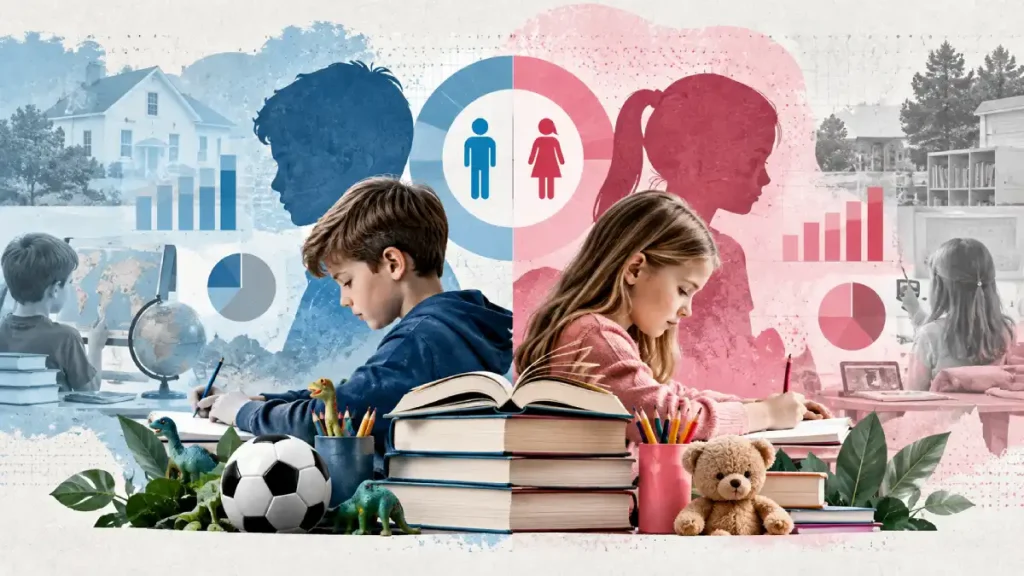

A mother in Ohio pulls her eight-year-old son out of third grade after the school issues three disciplinary citations in a single month for desk fidgeting during phonics drills.
Three states away, parents in Virginia file home instruction affidavits for their teenage daughter so she can accelerate through advanced algebra without the social distractions of a large high school.
These scenarios illustrate how differently families approach independent education depending on their child’s sex. Below are the verified federal numbers, historical benchmarks, and developmental factors that define the home education gender split in 2026.
Estimated share of the homeschool population
Estimated share of the homeschool population
Share of school age boys who are homeschooled
Share of school age girls who are homeschooled
National Gender Distribution and Benchmark Enrollment Rates
Federal demographic data reveals that the national homeschooling cohort has developed an unmistakable male skew following recent enrollment shifts. While overall participation rates expanded across every geographic region, parents of boys increasingly chose home instruction over conventional district assignments.
- Federal survey records from the National Center for Education Statistics show that 3.7% of school-age boys in the United States are homeschooled, compared to 3.1% of school-age girls.
- Across the broader home-instructed category, which includes both independent home learners and full-time remote learners, male students account for 5.4% of all school-age boys, while female students represent 5.0% of all school-age girls.
- Out of approximately 3.4 million children educated at home nationwide, boys represent roughly 1.89 million students, whereas girls make up approximately 1.51 million.
- Looking at the total homeschool population as an independent pool, boys hold an estimated 55.6% share, leaving girls with a 44.4% national share.
- In public virtual charter schools, enrollment trends slightly in reverse; girls hold a 1.9% share of total school-age female enrollment, compared to 1.7% for boys.
- Among families using pure parent-directed homeschooling with zero online public school affiliation, the boy and girl participation rates tie at 0.7% of the general population.
- Non-traditional home instruction reached 5.2% of all American school-age children in recent biennial counts, which is up from 3.7% recorded prior to 2020.
- Rural school districts log the highest raw home instruction rates across both sexes at 5.2%, outpacing suburban districts at 3.1% and urban centers at 2.1%.
Historical Gender Balance Shifts: 1999 to 2026
The gender ratio in home education has not remained static over the past three decades. Long-term survey data illustrates how home education shifted from rough parity in the late 1990s to a temporary female peak in the mid-2000s, before transitioning to a male majority in the post-2020 era.
- Benchmark survey data from 1999 covering 20,760 home-educated students recorded a near-even split of 50.2% female and 49.8% male learners.
- Federal tracking in 2003 documented near-identical baseline enrollment rates between sexes, registering 2.2% of all school-age boys and 2.1% of all school-age girls.
- Parent sample collections in 2007 registered an unusual female swing, with girls climbing to 58% of surveyed homeschoolers while boys fell to 42%.
- The 2012 National Household Education Survey logged a return toward historic parity, showing 51% female and 49% male representation across K-12 grades.
- By 2016, federal datasets documented girls taking the lead in overall participation rates, with 3.5% of school-age girls homeschooled compared to 3.0% of school-age boys.
- The 2019 pre-pandemic survey baseline documented an equal participation rate of 2.8% for both male and female school-age cohorts.
- Post-pandemic collections revealed a distinct male-led expansion; boys climbed to a 3.7% participation rate, while girls settled at 3.1%.
- Tracking across a 27-year window indicates that while girls represented the majority of home learners during the mid-2000s, boys represent the larger share of the home education cohort in 2026.
Grade Band Disparities: Elementary, Middle, and High School Splits
Student gender distribution fluctuates substantially depending on grade level and child maturity.
Boys dominate early elementary home enrollments where classroom structure often clashes with developmental pacing, while high school cohorts rebalance as older girls seek personalized academic schedules.
- In kindergarten through second grade, home education logs its highest participation mark at 4.0% of all US students, driven by early-elementary boys.
- Across grades 3 through 5, the national homeschooling rate remains high at 3.6%, with boys maintaining an elevated presence as parents address early literacy gaps.
- Middle school grades (grades 6 through 8) exhibit the lowest home education participation rate across grade spans at 3.0%, as families seek specialized lab instruction.
- In high school (grades 9 through 12), the home education participation rate rebounds to 3.1%, where the gender ratio shifts back toward female parity.
- High school home learners rely on full-time virtual course options at a rate of 3.5%, which is more than double the 1.5% virtual rate observed among middle school students.
- Early elementary home learners in grades K through 2 log the lowest dependence on remote public programs, with only 0.9% using full-time online schooling.
- State records from agencies tracking age bands show boys outnumbering girls by 1.3 to 1 in grades K through 4, whereas grades 10 through 12 show an even 1.0 to 1 ratio.
- Long-term tracking reveals that 28% of homeschooled boys transition back to traditional schools for high school sports and vocational shops, while 34% of homeschooled girls complete all four high school years at home.
Neurodiversity and Special Education Gender Ratios in Home Education
The intersection of neurodivergence and school withdrawal represents one of the strongest drivers of the male homeschool share.
Diagnostic disparities between the sexes in public school systems directly translate into asymmetrical home education transitions.
- Federal health registries indicate that boys receive Attention Deficit Hyperactivity Disorder (ADHD) diagnoses at 13% to 15%, compared to 6% to 7% for girls, creating a substantial gender gap among parents seeking flexible home settings.
- Autism Spectrum Disorder (ASD) diagnoses occur in boys at roughly 3.8 to 4 times the rate of girls, making autism-related public school departures predominantly male.
- Approximately 19% of parents homeschooling boys identify a diagnosed learning disability or neurodivergence as their main motivation for leaving institutional classrooms.
- Only 8% of parents homeschooling girls report learning disabilities or behavioral IEP designations as the primary trigger for home instruction.
- Field surveys of neurodivergent homeschool families indicate that 74% of parents with ADHD sons cite sensory overload and rigid sitting rules as direct exit triggers.
- Among students who held an active Individualized Education Program (IEP) before leaving public schools, boys outnumber girls by roughly 2 to 1.
- Speech and language delays represent the initial withdrawal trigger for 14% of homeschooled boys aged 5 to 7, compared to 6% of early-elementary girls.
- Clinical follow-up data shows that 82% of parents educating neurodivergent boys at home report measurable drops in child anxiety once 45-minute bell schedules are eliminated.
Classroom Mismatch and Behavioral Drivers for Boys
Institutional classroom structures frequently generate friction for male developmental patterns, especially regarding movement and stamina.
When schools reduce unstructured physical play and rely on strict disciplinary referrals, parents frequently opt out of institutional systems altogether.
- Public school discipline records document that male students receive roughly 70% of all out-of-school suspensions, motivating families to withdraw boys before disciplinary records compound.
- Elementary recess time has dropped by an average of 60 minutes per week across US school systems since 2001, conflicting directly with kinesthetic learning needs.
- Fourth-grade reading assessments show boys trailing girls by 10 to 12 scale points nationally, prompting many parents to homeschool boys early to build reading confidence without stigma.
- Parent survey responses show that 64% of families homeschooling boys sought a home environment that allows frequent physical movement and hands-on demonstrations.
- Elementary boys face 2.5 times more teacher referrals for behavioral evaluations than girls, which leads parents to choose home education to avoid negative labels.
- About 41% of parents with homeschooled boys identify frustration with zero-tolerance behavior policies as an influential factor in their school exit.
- Fine motor skill benchmarks show that boys develop pencil grasp stamina 6 to 12 months later than girls, a gap that flexible home pacing accommodates without punitive marks.
- Academic pacing records reveal that 58% of boys homeschooled in early grades perform at or above grade-level math standards when oral instruction replaces heavy seatwork.
Social Dynamics, Bullying, and Mental Health Drivers for Girls
While boys frequently exit early due to motor and behavioral mismatches, girls tend to leave traditional schools during adolescence due to psychosocial pressures.
Relational aggression, digital harassment, and academic stress combine to make home learning an emotional shelter for many teenage girls.
- National youth risk surveillance reveals that 57% of high school girls experience persistent feelings of sadness or hopelessness, nearly double the 29% reported by teenage boys.
- In public school settings, 22% of female students report on-campus bullying, while 27% report electronic bullying or cyberbullying, compared to 13% and 15% for male peers.
- Parental withdrawal surveys indicate that 36% of families homeschooling daughters in grades 6 through 12 identify toxic peer culture or relational bullying as their decisive exit motivation.
- Social anxiety and classroom panic episodes account for the primary homeschooling trigger in 24% of teenage female withdrawals, compared to only 9% among teenage boys.
- Clinical surveys show that 78% of parents homeschooling adolescent girls observe marked reductions in daily anxiety symptoms within four months of removing the child from social media pressure at school.
- Eating disorder recovery protocols integrate flexible home instruction in 18% of adolescent female cases, allowing medical monitoring without missing school credits.
- School refusal behaviors linked to chronic stress occur at a rate of 14% among high school girls transitioning into home education, outpacing boys by roughly 1.5 to 1.
- Academic safety audits indicate that 68% of parents with homeschooled daughters rank protecting their emotional and physical safety as a top decision factor, outpacing academic performance concerns.
Academic Achievement and Standardized Testing Outcomes by Sex
Standardized test scores confirm that home educated students perform exceptionally well regardless of sex.
The individualized nature of home instruction mitigates many of the gender gaps observed in traditional public school testing data.
- In nationwide testing samples of home learners, female students record a median composite achievement score in the 88th percentile, while male home learners average in the 86th percentile.
- Both male and female homeschoolers score 35 to 38 percentile points above national public school averages, which center at the 50th percentile across all standard grade levels.
- College readiness evaluations document that homeschooled females post an average composite ACT score of 22.8, compared to 22.4 for homeschooled males and 19.5 for national public school seniors.
- High school GPA registries show homeschooled girls averaging an unweighted GPA of 3.52, slightly ahead of homeschooled boys at 3.44.
- Standardized testing data shows that the score gap between high-income and low-income homeschool households shrinks to under 8 percentile points across both sexes, showing equal academic benefits regardless of income bracket.
- On SAT testing batteries, homeschooled females average 572 on the Evidence-Based Reading and Writing section, while homeschooled males score 564.
- Across the SAT Mathematics section, homeschooled males average 552, edging out homeschooled females at 544, mirroring national math testing distributions.
- Longitudinal academic studies demonstrate that homeschooled students maintain their percentile advantages across all four high school years, regardless of parental teaching credentials.
Subject-Level Performance: Reading Comprehension and Mathematics
Disaggregating homeschool performance by subject area reveals a significant narrowing of traditional literacy and numeracy gaps.
Home instruction appears especially beneficial for male reading development while maintaining strong female mathematics participation.
- While public school boys lag public school girls by 10 to 12 scale points on standard eighth-grade reading exams, homeschooled boys narrow that deficit to under 3 percentile points against homeschooled girls.
- Homeschooled girls score at the 89th percentile in reading comprehension nationally, while homeschooled boys achieve an 86th percentile median.
- In foundational elementary mathematics, homeschooled boys and girls post identical median scores at the 85th percentile.
- In advanced secondary mathematics (algebra II, pre-calculus, and calculus), homeschooled boys log an 83rd percentile average, compared to an 81st percentile mark for homeschooled girls.
- In language mechanics and written expression, female home learners hold an 87th percentile median, exceeding male home learners who register an 80th percentile median.
- Dual enrollment registries document that 42% of high school homeschooled boys enroll in community college STEM classes before graduation, compared to 36% of homeschooled girls.
- Advanced Placement (AP) exam records show homeschooled girls taking English Literature and Psychology exams at 1.4 times the rate of homeschooled boys.
- Diagnostic reading assessments demonstrate that 62% of dyslexic boys who transition to parent-led home instruction gain two full grade levels in reading fluency within 14 months.
Full-Time Virtual Enrollment vs. Independent Homeschooling Demographics
Educational delivery formats show measurable variation between male and female learners. While online public academies appeal to independent female study habits, boys frequently face digital fatigue, causing families to shift toward hands-on offline curricula.
- National education datasets establish that 1.9% of all school-age girls attend full-time virtual schools, exceeding the 1.7% enrollment share observed among school-age boys.
- In contrast, pure independent home education that uses offline, book-based, or unit-study models engages an identical 0.7% of boys and 0.7% of girls nationwide.
- Virtual charter school retention metrics reveal that 38% of enrolled elementary boys disengage or drop out within their first academic year due to screen fatigue and passive video lectures.
- Female students in virtual programs maintain an 81% full-year completion rate, aided by higher compliance with digital discussion boards and text-based assignment portals.
- Among families receiving state education vouchers or Education Savings Accounts (ESAs), 56% of female recipients select remote online academies, whereas 53% of male recipients use funds for physical tutoring, vocational trade modules, and offline curricula.
- Hybrid homeschooling programs that combine two days of physical classroom meetings with three days of home study report an even 50% male and 50% female student roster.
- Software engagement logs show that boys enrolled in digital home curricula spend 45% less time per lesson than girls, favoring gamified math modules over written composition prompts.
- Parent surveys show that 67% of families with sons who withdrew from full-time virtual schools replaced them with customized, tactile books and parent-taught lessons.
State Registration Discrepancies and Reporting Gaps
Because state homeschooling regulations range from mandatory annual rosters to zero reporting, national demographic patterns must account for substantial institutional blind spots.
- Only 15 states require parents to report student sex or age when filing mandatory home instruction notices, obscuring demographic tracking across most of the nation.
- In North Carolina, where registration records track individual students, official filings document that boys account for 53.2% of registered homeschoolers and girls represent 46.8%.
- Department of Education records in Delaware show male students holding a 52.6% share of active home school notifications, matching broader southern and mid-Atlantic trends.
- Nebraska Department of Education reports indicate that exempt home schools register 52.1% male students across compulsory attendance years.
- In low-regulation states like Texas, Oklahoma, and Illinois, where families submit zero student documentation, demographic researchers must rely exclusively on Census Bureau sampling models.
- Over 40% of the estimated US homeschool population resides in states with no student demographic reporting mandates, creating a 600,000-student gap between state registers and federal counts.
- Audit discrepancies reveal that states with high-regulation testing laws record 4% higher female representation in registration files because families with teenage girls show higher compliance with formal filing rules.
- State school choice portals that disburse taxpayer funds require formal gender tracking, creating demographic registries that capture 15% to 20% more male students than traditional notice-of-intent databases.
Cross-National Comparisons: US Data vs. UK Home Education Censuses
Evaluating international home education data shows the unique profile of the American male-led homeschool expansion. In the United Kingdom, official census figures demonstrate the opposite demographic reality.
- The UK Department for Education mandatory Elective Home Education census in Autumn 2025 recorded that 52% of home-educated children in England are female and 48% are male.
- Prior Autumn 2024 census returns in England documented a similar female lead, with 51% female, 48% male, and under 1% recorded as unknown.
- This British demographic profile directly inverts the general school population in England, which registers 51% male and 49% female across state-funded schools.
- While American homeschool numbers show boys leading with a 55.6% share in post-pandemic federal data, British figures reflect a sustained female majority in home education.
- British local councils record mental health as the primary reason for elective home education in 16% of cases where parents provide reasons, a metric that rose from 14% in 2024 and tracks closely with female withdrawals.
- In Canada, provincial Ministry of Education data from Alberta and British Columbia documents an even 50.5% male and 49.5% female distribution among registered home educators.
- Australian home education registries in New South Wales and Victoria report that boys account for 54% of registered homeschoolers, aligning with the American pattern of male-driven neurodivergent exits.
- Cross-national surveys demonstrate that nations centered on academic school refusal frameworks see female majority home education, whereas nations with expansive school choice vouchers see male-majority enrollment.
Family Economics, Household Structure, and Instructor Demographics
Home instruction requires substantial parental time investments and financial adaptability. Examining household structures reveals that family stability, income distribution, and maternal teaching roles shape the day-to-day delivery of home curricula.
- Federal surveys report that 79% of home-educated children live in two-parent married households, compared to 65% of traditional public school students.
- In single-parent homes, the homeschooling participation rate drops to 1.6%, compared to 3.9% in two-parent households, reflecting the time constraints of parent-led instruction.
- Mothers serve as the primary homeschool instructor in 77% of households, while fathers serve as primary instructor in 11%, and both parents divide teaching equally in 12%.
- Household income tracking indicates that 48% of homeschool families earn between $50,000 and $100,000 annually, while 26% earn over $100,000 and $2650,000.
- In households where parents hold a bachelor degree, the homeschooling rate stands at 3.8%, compared to 3.0% for parents with graduate degrees and 2.8% for high school graduates.
- Among families homeschooling boys, fathers contribute 6.5 hours per week of direct instruction on average, compared to 3.8 hours per week in households homeschooling girls, concentrating on math and technical sciences.
- Single mothers homeschooling sons report higher rates of public virtual program usage at 46%, compared to 31% among two-parent households.
- Non-English speaking households record a homeschooling participation rate of under 0.5%, reflecting the high English literacy demands of parent-directed curricula.
Extracurricular Engagement, Athletics, and Community Integration
Socialization and athletic participation patterns differ sharply between homeeducated boys and girls. Families take advantage of state legislative protections and local community leagues to build well-rounded schedules outside the home.
- State legislation known as Equal Access or Tim Tebow laws permits homeschooled students to participate in public school athletic teams in 36 states.
- High school homeschooled boys register for interscholastic public school athletic tryouts at 2.4 times the rate of homeschooled girls, prioritizing football, baseball, and wrestling rosters.
- In states without equal access laws, 61% of homeschooled boys join independent club sports leagues, martial arts gyms, or community soccer programs.
- Extracurricular participation records show homeschooled girls participate in community theater, dance academies, and visual arts studios at 1.8 times the rate of homeschooled boys.
- Cooperative learning groups, or homeschool co-ops, serve 53% of all home-educated students, meeting an average of 1.2 days per week for laboratory science and group electives.
- Volunteer service tracking documents that homeschooled high school girls log an average of 84 volunteer hours per year, compared to 58 hours per year for homeschooled boys.
- Scouting and outdoor survival programs enroll 38% of homeschooled boys aged 8 to 14, compared to 14% of traditionally schooled boys nationwide.
- High school physical education benchmarks show homeschooled children logging 140 minutes per week of structured aerobic activity, exceeding public school averages by 25 minutes.
Secondary Pathways: Dual Enrollment, Graduation, and Postsecondary Transitions
The culmination of home education reveals diverse paths to adulthood. Rather than lagging behind their peers, homeschooled students transition into higher education and skilled trades with established credentials and reduced remediation requirements.
- College transition registries document that 67% of homeschooled high school graduates matriculate directly into two-year or four-year postsecondary institutions, exceeding the national average of 62%.
- Among homeschooled students who attend college, females achieve a four-year degree completion rate of 66%, while males achieve a completion rate of 58%.
- Dual credit participation rates show that 46% of homeschooled high schoolers earn at least three college semester credits prior to high school graduation.
- Gender tracking in dual enrollment shows that female home learners complete an average of 14.2 college credits before age 18, compared to 11.8 credits for male home learners.
- In career and technical education (CTE), 29% of homeschooled boys enter post-graduation skilled trade apprenticeships in electrical, HVAC, and carpentry fields, compared to 7% of homeschooled girls.
- Entrepreneurship tracking indicates that 16% of homeschooled males launch an active business or independent contracting venture by age 21, compared to 9% of public school graduates.
- College admissions data reveals that homeschooled females receive merit-based academic scholarships at a rate of 44%, compared to 38% for homeschooled males.
- Remedial coursework rates in freshman college cohorts stand at only 11% for former homeschoolers across both sexes, compared to 28% for traditional high school graduates.
Recent Developments
State legislative reforms in 2025 and 2026 have fundamentally reshaped the financial feasibility of home-based education. Universal school choice programs and microschool cooperatives have expanded options for families across the country.
- By early 2026, 12 states have implemented universal Education Savings Account (ESA) programs, allowing all school-age families to access taxpayer funding regardless of household income.
- National participation in ESA programs surpassed 1.2 million students in 2026, backed by more than $10.8 billion in total state appropriations.
- The Arizona state ESA program exceeded 100,000 enrolled students in January 2026, with 72% participating under universal eligibility rules.
- Statutory classifications in most ESA states formally distinguish ESA participants from traditional homeschoolers, subjecting funded families to state testing or curriculum approvals.
- In Florida, the state Family ESA program maintained a capacity ceiling of 140,000 students for the 2026-2027 funding cycle.
- The launch of the Texas Education Freedom Account generated over 274,000 applications, establishing separate funding tiers for home-based instruction and private school tuition.
- West Virginia expanded its Hope Scholarship into full universal status for the 2026-2027 school year, permitting traditional home educators to apply for account access.
- Microschool networks and hybrid educational pods expanded to serve an estimated 420,000 students in 2026, providing two-day to three-day weekly classroom structures that bridge homeschooling and institutional schools.
Editor’s Choice
- 55.6% vs. 44.4%: The post-pandemic gender split among US home learners favors boys, driven by a national participation rate of 3.7% for school-age boys compared to 3.1% for girls.
- 2 to 1 Special Education Ratio: Boys with pre-existing IEP designations outnumber girls two to one among public school departures, establishing neurodiversity management as a primary driver of male home education.
- 88th and 86th Percentiles: Standardized testing demonstrates academic parity between sexes in home environments, with girls at the 88th percentile and boys at the 86th percentile, both outpacing the public school 50th percentile baseline.
- 10-Point Reading Deficit Compression: Homeschooled boys cut the standard national literacy gap against girls from 10 to 12 points in public schools down to under 3 percentile points under individualized pacing.
- 52% Female in English Censuses: International comparison reveals an inverted demographic in the UK, where girls represent 52% of elective home learners in official Autumn 2025 counts, compared to 48% boys.
- 70% Out-of-School Discipline Disparity: Heavy institutional suspension rates concentrated among male students motivate 41% of parents homeschooling boys to seek alternatives to zero-tolerance policies.
- 57% Adolescent Mental Health Crisis: Severe persistent sadness among high school girls drives 36% of parent withdrawals for teenage daughters seeking refuge from relational bullying and digital harassment.
- 1.2 Million ESA Beneficiaries: The rise of universal school choice across 12 states has infused over $10.8 billion into parent-directed learning, expanding hybrid microschool models for both sexes in 2026.
Frequently Asked Questions
Federal education data indicates that boys make up 55.6% of the American home education population, leaving girls with a 44.4% national share. In total student counts, this represents approximately 1.89 million boys and 1.51 million girls out of 3.4 million total home learners.
Boys receive roughly 70% of public school disciplinary suspensions and face Attention Deficit Hyperactivity Disorder diagnoses at rates between 13% and 15%, compared to 6% to 7% for girls. Consequently, 64% of parents homeschooling boys cite the need for flexible movement and practical learning as their primary reason for school withdrawal.
Homeschooled girls score at the 88th percentile median on composite standardized tests, while homeschooled boys achieve an 86th percentile median, placing both sexes roughly 36 percentile points above the national public school average of 50%. On college entrance exams, homeschooled girls average 22.8 on the ACT compared to 22.4 for homeschooled boys.
Female students lead enrollment in full time virtual public schools, representing 1.9% of the national school age female population, compared to 1.7% for males. Program completion data shows that female students maintain an 81% full year completion rate, whereas 38% of elementary boys disengage from virtual screens within their first academic year.
Official government census figures from England show an inverted split, recording 52% female and 48% male home learners in late 2025 counts, compared to a general school population that is 51% male. In contrast, Australian registries track American patterns with boys accounting for 54% of home educated children.
- National split: Boys account for an estimated 55.6% of the United States homeschool population.
- Diagnosis gap: ADHD diagnoses are reported more often for boys than girls.
- International comparison: England reports a female majority among electively home educated children.
Conclusion
Data from 2026 demonstrates that families do not choose home education for homogenous reasons. Boys enter home instruction primarily during elementary grades as parents navigate classroom behavioral friction, recess reductions, and neurodivergent learning needs.
Girls increasingly transition into home learning during secondary grades to escape intense social media pressure, relational bullying, and adolescent mental health strains. While policy developments like universal Education Savings Accounts alter the legal definitions of home instruction, the underlying academic outcomes show consistent strength across both sexes.
Understanding these gender-specific patterns enables educators, policymakers, and families to design learning environments that support the developmental trajectories of every child.
Sources and editing
This article cites state departments of education, the National Center for Education Statistics (NCES), U.S. Census Bureau Household Pulse surveys, and peer-reviewed research.
We may use AI tools to sort tables or improve wording. A human reviewer checks the numbers, citations, and claims before publication.