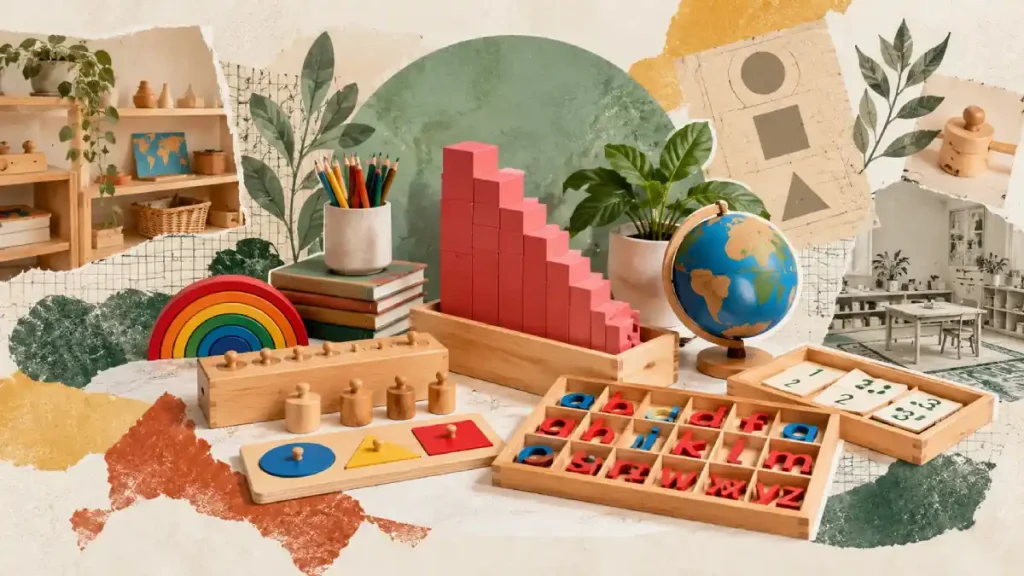
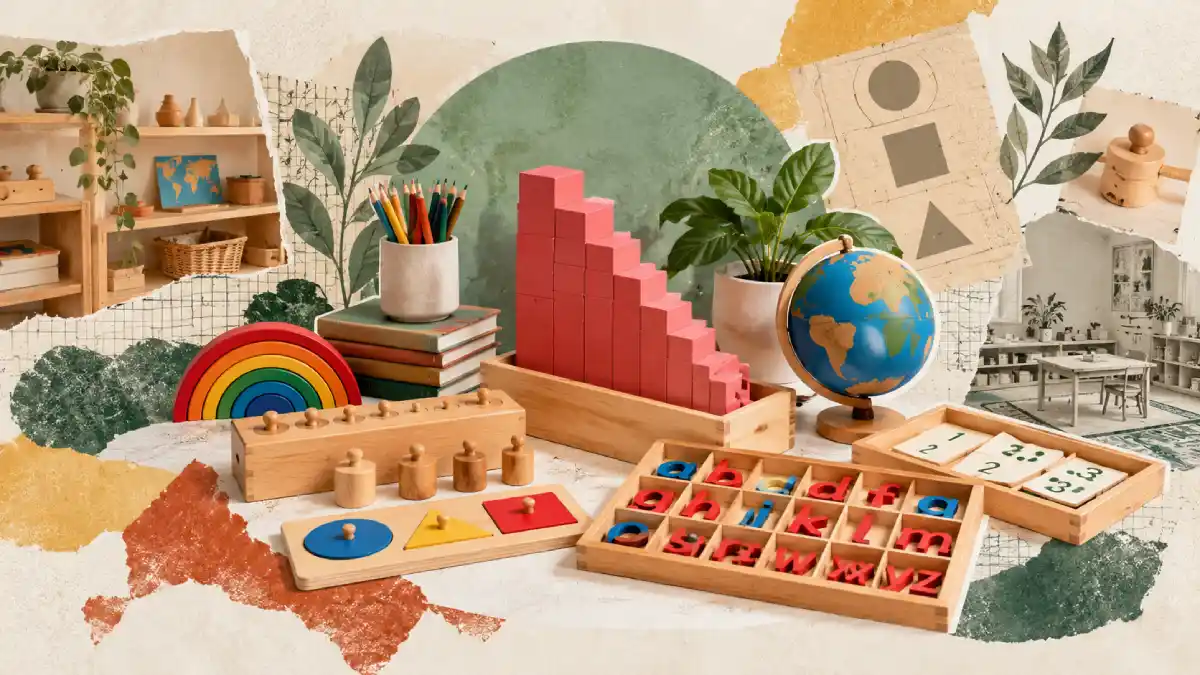

Parents turn to Montessori homeschooling because they want their children to learn through hands-on discovery. A four-year-old struggles to sit still for dry worksheets, but thrives with wooden letters and counters. Nearby, a toddler parent seeks simple ways to build motor skills without plastic toy clutter.
Setting up a functional montessori at home curriculum can feel overwhelming without a clear roadmap. Parents often wonder whether they must purchase every wooden manipulative or complete formal teacher training. This guide explains actual curriculum costs, popular learning formats, and age-specific stages for early childhood through elementary years.
American students educated at home across the country
Spent each year on curriculum packages and materials
Cost of quality wooden materials in year one
Fees for private primary programs nationwide
Montessori Homeschool Curriculum Market Size and Growth
About 3.4 million American students learn at home, and many parents now choose Montessori materials. Years ago, parents had to hunt down rare teacher albums or craft bead bars themselves. Today, the 530-million-dollar homeschool curriculum sector features dozens of dedicated Montessori publishers.
Publishers now design programs specifically for kitchen tables rather than large classrooms. Selecting the best montessori homeschool curriculum comes down to finding lessons that match your daily family lifestyle. That commercial shift explains why child-led home education continues to spread into the mainstream.
Annual Family Spending on Montessori Homeschool Curricula
Homeschooling with Montessori methods does not require an immense bank account. Most families spend between $600 and $1,500 per child annually on curriculum packages and essential materials. That range aligns with national figures for how much homeschooling costs.
Some states also offer credits or deductions for qualifying home education costs. See our homeschool tax credit guide for examples.
Overall household investments generally fall into three distinct expense categories:
- Core curriculum guides and digital scope-and-sequence plans cost between $100 and $500.
- Classic physical manipulatives like the pink tower, golden beads, and movable alphabet cost between $300 and $700.
- Practical life tools, art supplies, and consumable paper goods require roughly $100 to $250 each year.
Resourceful parents frequently cut these expenses in half. Many buy pre-loved wooden materials from local co-ops or online parent groups. Others rotate a few purposeful items across subjects, which keeps clutter low and focus sharp.
Cost Comparison: Home Montessori vs. Private Montessori Tuition
Private Montessori tuition gives most families sticker shock. Across the United States, tuition fees for private primary programs run between $12,000 and $20,000 each year. In major cities, full-day tuition often exceeds $30,000 once mandatory fees kick in.
Homeschooling flips that financial equation entirely. Setting up a home learning environment with quality wooden materials costs roughly $1,000 in your first year. In later years, annual expenses often drop below $400 because you already own the foundational equipment.
That means you can reduce your educational costs by roughly 90 to 95 percent. Parents redirect those savings into library trips, gymnastics lessons, museum memberships, and family travel. You get the child-led philosophy without taking on a second mortgage.
Home Montessori vs Private Montessori Costs
Annual Comparison| Cost Category | Home Montessori | Private Montessori | Cost Reduction | Basis |
|---|---|---|---|---|
| First-Year Setup | $1,000 | $12,000-$20,000 | 90 to 95% lower | Materials vs annual tuition |
| Recurring Annual Cost | Under $400 | $12,000-$20,000 | 90 to 95% lower | Wooden materials reused |
| Major-City Full-Day Tuition | $1,000-$1,500 | Over $30,000 | About 95% lower | Mandatory fees included |
Multi-Age Reusability and Household Cost Efficiencies
Montessori materials represent one of the most durable educational investments a family can make. Unlike consumable workbooks that you discard each spring, authentic wooden equipment lasts for decades.
A single set of golden beads serves a preschooler learning place value and later teaches an older sibling division. Sandpaper letters, botany classification cards, and the pink tower naturally pass from one child to the next. That multi-year durability cuts per-child expenses significantly as your family grows.
Multi-age homes also unlock natural peer learning:
- Older children reinforce mastery by presenting basic lessons to younger siblings.
- Younger children absorb vocabulary simply by watching older brothers and sisters work.
- Shared practical life routines like meal preparation engage every child simultaneously without extra curriculum purchases.
Families who invest in durable core resources during the early years spend very little when younger children reach school age.
Curriculum Formats: Boxed Sets, Digital Subscriptions, and Printables
Parents pick from three primary formats based on budget, free time, and teaching confidence. Each option provides a different balance between parent preparation and open-and-go convenience.
Boxed curriculum kits deliver physical lesson manuals alongside authentic hands-on manipulatives. ShillerLearning is a classic example of this open-and-go style. Their scripted math and language kits require no teacher training, making home lessons simple.
Digital memberships pair video lesson libraries with active community mentorship. Platforms like Child of the Redwoods and Guidepost Homeschool provide weekly schedules and parent-coaching calls. These $25 to $99 monthly subscriptions offer clear video guidance for each presentation.
Printable albums suit parents who want maximum flexibility and low startup costs. Sellers like Multisori offer downloadable PDF albums containing lesson albums, scope charts, and three-part cards. You print pages on cardstock, laminate what you need, and organize everything into simple binders.
State Education Savings Accounts (ESAs) and Curriculum Funding
School choice policies have expanded rapidly, changing how families finance home education. Over 18 states now operate active Education Savings Account programs, distributing over $13 billion annually to participating students. Our homeschool funding by state tracker shows how each program works.
Typical ESA awards range between $5,000 and $9,500 per child each school year. These public funds help parents purchase approved curricula, digital subscriptions, and essential learning tools through portals like ClassWallet and Odyssey.
Montessori families benefit substantially from this policy wave:
- Approved vendors like Maitri Learning supply authentic card sets and reading materials through state platforms.
- Specialized manipulatives, microscopes, and reference books qualify for purchase using scholarship funds.
- Certified tutors and enrichment workshops can be hired without paying out of pocket.
Always check your specific state portal before ordering materials. ESA rules strictly prohibit reimbursement for unapproved purchases, so families must verify vendor status inside their state marketplace.
Early Childhood and Primary Adoption Rates (Ages 0 to 6)
Most families start their Montessori journey during the first plane of development. Parents searching for a montessori preschool homeschool curriculum find that toddlers absorb vocabulary and motor skills quickly.
For toddlers from birth to age three, formal paper curricula are basically unnecessary. You prepare your living spaces instead. Low open shelves, child-height coat hooks, and small wooden step-stools do far more good than workbooks. Toddlers thrive on real tasks like pouring water, peeling fruit, and sweeping crumbs with mini brushes.
Adopting a montessori homeschool curriculum 3 6 introduces tactile sensorial materials and structured routines. Parents introduce sandpaper letters for phonics, wooden number rods for counting, and the pink tower for size discrimination.
Families exploring a montessori kindergarten curriculum homeschool option discover that five-year-olds flourish with self-correction. Children build sustained focus, physical dexterity, and mathematical intuition before formal primary school begins. That solid foundation makes the shift to elementary reading and math far smoother down the road.
Elementary Curriculum Continuation and Retention (Ages 6 to 12)
Many families step away from pure Montessori when their children reach the elementary years. During the primary stage, setting up practical life and sensorial trays feels intuitive. In contrast, elementary education introduces Cosmic Education, which starts with the broad universe before studying specific details.
Maria Montessori introduced the Five Great Lessons as grand stories to ignite imagination. These stories cover the creation of Earth, the origin of life, and the development of language and mathematics. Children use these foundational stories to launch self-chosen research projects across science and history.
Retention dips around second or third grade for several practical reasons, a pattern that shows up in our homeschool statistics by grade:
- Curriculum anxiety leads parents to worry about matching standardized grade-level expectations for testing.
- Subject depth in upper elementary requires deeper specialized knowledge in geometry, botany, and history.
- Social needs expand as older children crave peer interaction that single-child home settings struggle to deliver.
Families who stick with the method often join local homeschool co-ops or nature study groups. This balance gives elementary learners social discussion while preserving their freedom to pursue deep academic interests.
Daily Work Cycle Duration and Parent Preparation Time
Traditional Montessori classrooms run on three-hour uninterrupted work blocks. At home, children rarely need that much continuous time to finish their daily assignments.
Most elementary homeschoolers thrive with a focused morning work cycle lasting 90 minutes to two hours, which matches our guidance on how many hours to homeschool per day. Because home education eliminates line transitions and whole-class disruptions, children cover significant material in a fraction of normal school hours. After finishing focused math and language presentations, students spend their afternoons on independent reading, nature studies, or music.
Parent preparation time shifts as children mature. Instead of preparing delicate sensory trays each night, parents become project facilitators. Spending one hour on Sunday reviewing work plans and gathering library books usually sets up the entire week. During the actual school day, parents give short ten-minute lessons and then step back to let the child explore independently.
Physical Manipulatives and Prepared Environment Investments
The elementary years mark the slow transition from concrete physical objects to pure mental abstraction. While younger kids need full sets of wooden equipment, older students gradually leave materials behind.
Certain manipulatives remain essential for lower elementary work. The math checkerboard and flat bead frames make multi-digit multiplication visual and tactile. Sentence analysis charts and colored grammar symbols help students dissect complex parts of speech through hands-on classification.
You do not need to buy an entire catalog of specialized equipment:
- Wooden math materials can be purchased second-hand or shared across multi-age siblings.
- Grammar symbols and timeline charts work exceptionally well as printable cardstock files.
- Real-world tools like microscopes, plant presses, and graph paper replace expensive custom trays.
Keeping shelves uncluttered helps older children focus. A well-ordered bookcase, labeled supply bins, and plenty of table space create a workspace that respects their growing maturity.
Core Subject Distribution: Practical Life, Sensorial, Math, and Language
Subject balance looks very different in elementary than it does in preschool. Practical life tasks move out of the kitchen and into the real world.
Sensorial work transitions directly into geometry and scientific observation. Instead of sorting colored cylinders, students measure geometric angles, classify leaf margins, and sketch rock specimens. Concrete sensory habits now serve disciplined academic study.
Math and language occupy substantial daily energy. Math moves steadily from bead frames to paper calculations, teaching students the underlying mechanics before introducing standard algorithms. Language work emphasizes creative story composition, spelling analysis, and structured grammar parsing.
Cosmic education ties these separate subjects into a cohesive whole:
- History studies on ancient civilizations incorporate geography map-making and cultural research.
- Biology projects on seed dispersal connect directly to mathematical graphing and outdoor observation.
This interconnected approach keeps daily learning meaningful rather than dividing knowledge into artificial 45-minute periods.
Academic Outcomes and Executive Function Benchmarks
Parents often ask whether child-led methods prepare children for future academic standards. Solid clinical research consistently answers that question with a clear yes.
A nationwide 2025 study led by Angeline Lillard tracked 588 students across 24 public Montessori schools. Published in the Proceedings of the National Academy of Sciences, the research utilized lottery admissions to eliminate student selection bias. By the end of kindergarten, Montessori students demonstrated significantly stronger outcomes in reading, short-term memory, and social understanding.
Executive function gains represent the most compelling research finding. Children who practice choosing tasks, organizing their materials, and correcting their own errors build exceptional impulse control and mental flexibility.
A broad 2023 meta-analysis covering 32 separate studies confirmed similar positive impacts across math and creative problem-solving. Children who manage their own study habits early build strong focus that benefits every future subject.
- Lower Annual Cost ($600 to $1,500): Most families spend between $600 and $1,500 per child each year on Montessori curriculum packages and essential materials.
- Large Savings vs Private Tuition (90 to 95%): A home setup costs about $1,000 in year one, while private primary tuition runs $12,000 to $20,000 each year and tops $30,000 in major cities.
- Strong Kindergarten Outcomes (588 students): A 2025 study led by Angeline Lillard tracked 588 students across 24 public Montessori schools and found stronger reading, memory, and social understanding by the end of kindergarten.
- Growing Public Funding (18 states): Over 18 states now run Education Savings Account programs that distribute more than $13 billion a year, with awards of $5,000 to $9,500 per child.
Parental Motivations and Demographic Profile
Modern Montessori homeschoolers reflect a wide cross-section of families. Recent demographic estimates show that over 41 percent of American homeschool households identify as racially diverse. Families come from rural homesteads, suburban neighborhoods, and downtown apartments alike. Those patterns track with our homeschooling by race and ethnicity data.
Parents choose this educational path for distinct personal reasons:
- Intrinsic motivation takes priority over chasing gold stars and letter grades.
- Peaceful household rhythms replace the chronic stress of rigid school schedules.
- Individualized pacing accommodates active learners, gifted thinkers, and neurodivergent children, and our homeschooling special needs guide covers the legal and curriculum side.
This diverse parent base values autonomy and hands-on competence. Families do not adopt Montessori to build miniature prep schools. They choose it because it honors the child as a capable individual.
Implementation Friction and Curriculum Abandonment Factors
Homeschooling with Montessori methods also brings real daily challenges. Many parents step away after a year or two because unrealistic expectations create burnout.
The most common trap is the aesthetic illusion. Social media displays immaculate wooden classrooms with color-coded shelves, leading parents to believe their home must match a showroom. When living rooms get messy or children resist prescribed materials, parents assume the method has failed.
Several practical friction points frequently derail beginners:
- Overbuying materials upfront before understanding how to present lessons causes unnecessary financial stress.
- Enforcing rigid schedules instead of following natural household rhythms sparks power struggles.
- Social isolation can occur when older elementary students crave outside peer discussion.
Successful families treat Montessori as a mindset rather than a rigid catalog. They focus on simple observation, rotate materials slowly, and give themselves grace when days get chaotic.
Recent Developments
The home Montessori ecosystem has evolved significantly over the past two years. Digital tools, public policy shifts, and fresh academic research have expanded options for everyday families.
State Education Savings Accounts now operate across 18 states, funding approved vendors like Maitri Learning directly through public portals. Families use these scholarship dollars to acquire quality wooden manipulatives and digital curriculum subscriptions without tapping personal savings.
Modern technology has also simplified lesson planning:
- On-demand video platforms deliver visual demonstrations for hundreds of traditional presentations.
- Digital curriculum trackers help parents monitor skill mastery without maintaining manual record books.
- Cooperative lending libraries enable local parent groups to share expensive upper-elementary science gear.
Meanwhile, landmark 2025 research published in PNAS demonstrated that public Montessori students gain significant advantages in reading and executive function. That scientific validation gives home educators added confidence in child-led learning.
Editor’s Choice
Choosing the right curriculum options can feel confusing. These proven options stand out for quality, parent support, and instructional clarity:
- Best Scripted Kits: ShillerLearning offers open-and-go math and language packages with physical manipulatives that require zero teacher training.
- Best Digital Membership: Child of the Redwoods provides structured monthly plans, weekly coaching, and a supportive parent community.
- Best Printable Scope: Multisori delivers detailed digital PDF albums and three-part cards that give parents full customization at modest cost.
- Best Pedagogy Reference: North American Montessori Center manuals offer professional-grade lesson presentations for parents wanting authentic albums.
Frequently Asked Questions
A Montessori homeschool curriculum is a developmental learning framework based on child led work, prepared environments, and tactile learning materials across practical life, math, language, sensorial exploration, and cultural studies. Rather than following rigid daily textbooks, parents guide children through sequential hands on presentations at their natural individual pace.
Most families spend between 600 and 1,500 dollars per child annually on manuals, digital scopes, and wooden manipulatives. Digital subscriptions generally run 25 to 99 dollars per month, while printable PDF packages cost 100 to 500 dollars.
Yes, parents can successfully teach Montessori at home without formal educator certification. Modern open and go curriculum kits and video guided memberships provide clear, step by step instructions for presenting every material.
No official accrediting agency certifies individual homeschool curricula because Maria Montessori never trademarked her name. Accreditation applies only to brick and mortar schools, though parents can choose recognized publishers whose lesson albums follow authentic guidelines.
Most elementary homeschoolers need only 90 minutes to two hours of focused morning work to make steady academic progress. Preschool children typically thrive with flexible 30 to 60 minute periods of purposeful practical life and sensory play.
Conclusion
Starting a Montessori homeschool does not require a complete home overhaul or a teaching degree. The method succeeds through observation, respect, and thoughtfully prepared spaces.
Begin with simple practical life tasks and a few sturdy wooden materials. Let your child explore at their natural pace, and remember that true learning happens through real everyday living. With patience and consistent rhythm, home Montessori creates a lasting love for discovery.
Sources and editing
This article cites state departments of education, the National Center for Education Statistics (NCES), U.S. Census Bureau Household Pulse surveys, and peer-reviewed research.
We may use AI tools to sort tables or improve wording. A human reviewer checks the numbers, citations, and claims before publication.